Outgrown Klaviyo (or our current email/SMS tool)
The flows you keep postponing because the tool cannot build them
Ecommerce brands get Maestra Platform, an all-in-one retention marketing platform, plus a forward-deployed marketer who rebuilds those postponed flows instead of handing you a help article.
Brands running on Maestra






The problem
A fragmented stack, a fragmented view of the customer
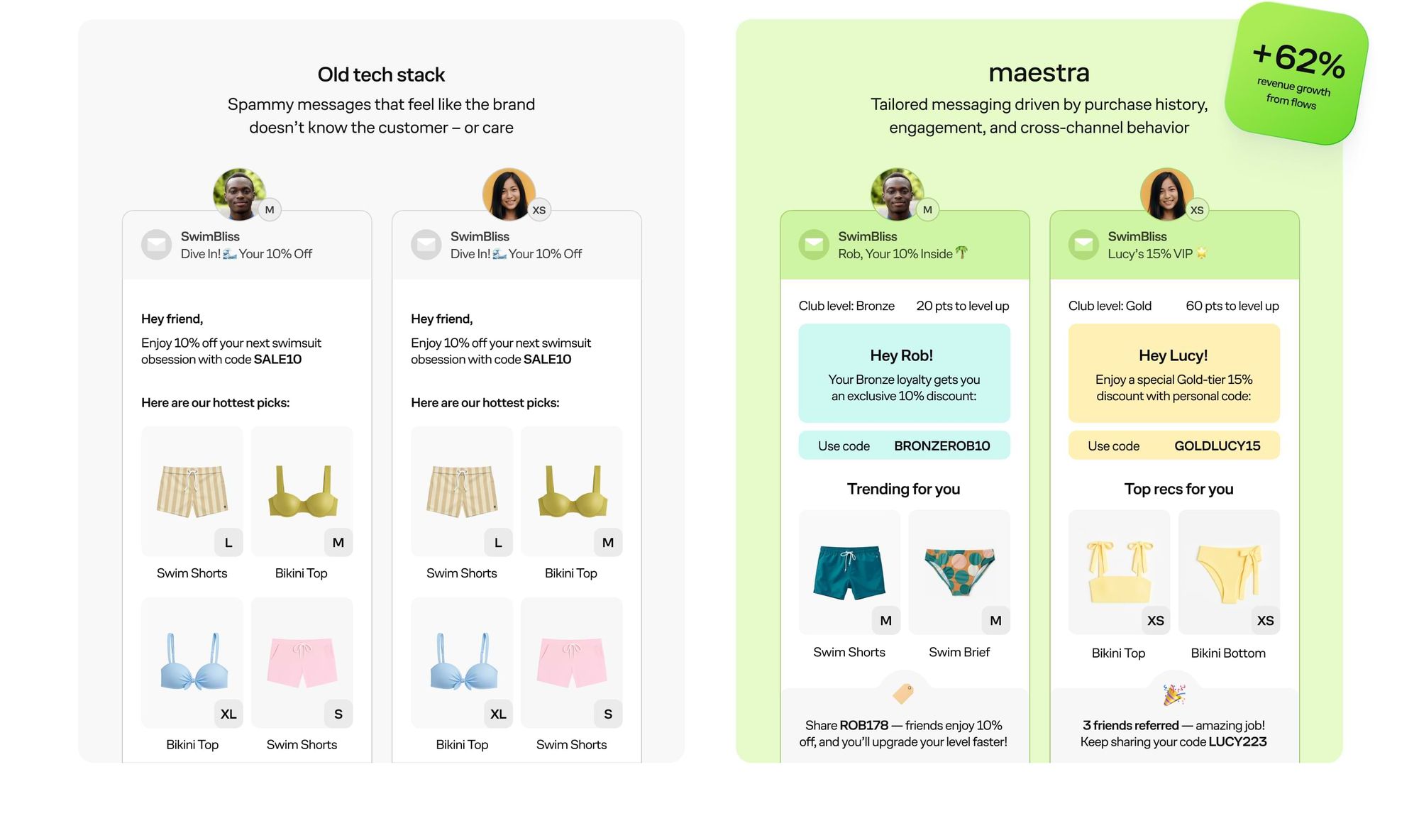
Email lives in one tool, SMS in another, loyalty somewhere else entirely. Teams end up stacking exclusions and workarounds just to avoid sending the wrong message twice, and no one has a single, trustworthy view of what a customer actually did.
What we hear from brands
Expensive, fragmented stack with minimal personalization and no A/B testing, says an indoor-gardening brand on a legacy tool plus a loyalty add-on
Segmentation and SMS alignment insufficient, the tools prevent unified customer journeys and deep personalization, says a home-lighting brand
Flows only cover basic cart and browse abandonment, email performance declining amid fierce competition, says an independent fragrance boutique
The new way
A single platform, not a patchwork
Maestra combines a real-time customer data platform, email, SMS, push, on-site personalization, and loyalty in one system, so a brand's data does not stay locked inside a single channel. Every subscription includes a dedicated forward-deployed marketer, not a separate line item for strategy.
8.6x
campaign-driven revenue growth year-over-year compared to the old platform
From a published case studyFull week
of work time saved over five months through streamlined operations
From a published case studyCustomer proof
Enlightened Equipment turned 0.37% of visitors into subscribers, then 6.1%

The old tool offered nothing worth calling lead capture, so almost every visitor left anonymous. A dedicated marketer launched no-code lead forms with frequency control and kept A/B testing them until the subscriber rate stopped being a rounding error.
0.37% → 6.1%
of website visitors become subscribers
How it works
Who does what during the switch
You approve the plan
Access to the current stack and a yes to the migration plan is the whole ask on your side.
Your marketer rebuilds
Data, flows, and campaigns are rebuilt on Maestra while the tools you are leaving keep sending, including the domain warm-up that protects deliverability.
You switch when it is ready
Two to four weeks for growing brands, three to seven for the most complex setups, and 99% of the work sits with your marketer either way.
The platform
One system for the whole customer journey
From the first site visit to the tenth purchase, Maestra runs on a commerce-specific data model that keeps CDP, journeys, loyalty, and messaging in sync. The platform is built to process 2M RPM at under 300 milliseconds, so that sync holds up under real traffic.
Your forward-deployed marketer
Included, not an upsell
The forward-deployed marketer comes with the subscription rather than as a services line item, and the work is implementation: building flows, launching campaigns, and fixing what the reporting exposes.
Included with every subscription, not billed separately
Implementation work, not advice on a call
Weekly calls and a shared Slack channel
Replace your stack
The tools you are replacing, and why it works
Email platforms, SMS senders, and recommendation engines all read from their own database. Maestra unifies those functions so recommendations know what the SMS just sent, and the SMS knows what the email already tried.
Have a look at the platform first
You do not have to decide anything to see how the pieces fit together. Start on the product pages and work back to your own stack.